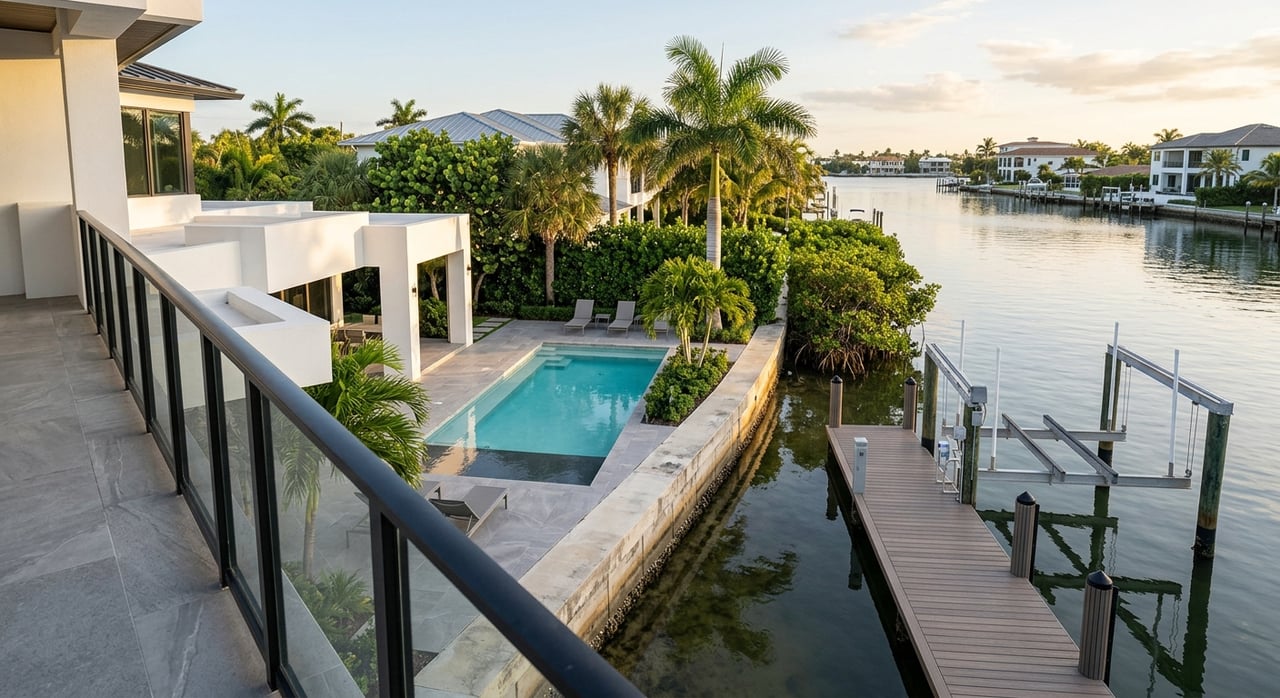
Wondering whether a Gulf Coast waterfront home has the right dock for your boat and your lifestyle? That question matters more than many buyers expect, because the "best" dock setup depends on water depth, tides, permitting, shoreline conditions, and the upgrades you may want later. If you are shopping for a Florida Gulf Coast home with boating in mind, this guide will help you compare common dock options, understand what can affect future changes, and ask smarter questions before you close. Let’s dive in.
Common dock types
When you look at waterfront homes along Florida’s Gulf Coast, you will usually see a few common residential dock configurations. The right fit often depends on the shoreline, the size of your boat, and how you plan to use the property day to day.
Fixed docks
A fixed dock, also called a pile-supported dock, is a permanent structure with pilings, supports, decking, and related features used to secure and access a vessel. Sarasota County’s dock guidance recognizes this as one of the standard residential dock forms.
For many buyers, a fixed dock offers a stable platform for boarding, loading gear, or enjoying the water view. It can work well on many Gulf Coast waterfront lots, but the design still needs to match the site conditions and any local permitting requirements.
Floating docks
A floating dock rises and falls with the water level, which can make boarding easier in some situations. Sarasota County’s definitions also include floating docks as a standard dock type.
Because Gulf tides can be influenced by wind and weather, flexibility in water level can be useful. That said, floating docks are still site-specific, so you will want to confirm whether the existing setup works with the property’s water depth and intended vessel use.
Marginal docks
A marginal dock is typically placed right beside a vertical bulkhead or within five feet of a revetment. According to Sarasota County guidance, this is why many seawall lots have compact dock layouts.
If you are buying on a canal or along a seawall, this type of setup may be common. It can be a practical option where space is limited, but you still need to check whether it fits your boat’s beam, boarding needs, and future lift plans.
Finger piers and terminal platforms
Some docks include a terminal platform at the end, sometimes with finger-pier elements to help with securing, loading, or unloading a vessel. The Florida Department of Environmental Protection dock permitting guide explains that the terminal platform is the end portion used for those functions.
For buyers, this layout can make day-to-day boating easier. It may improve access around the boat, but it also becomes part of the larger design and permitting picture.
Boat lifts and davits
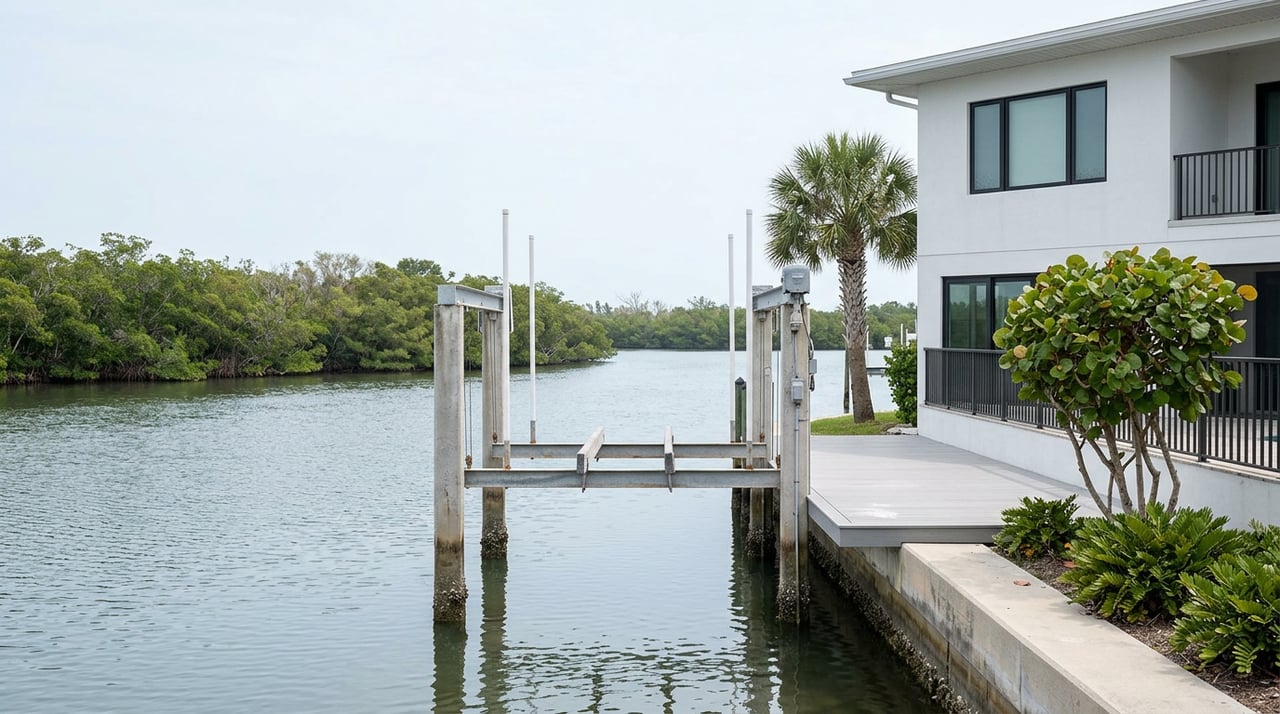
If keeping your boat out of the water is part of your plan, a lift or davit setup may be important. Sarasota County defines a boat lift as a fixed or floating device used to lift, hoist, and launch vessels, while a davit is a cantilevered lifting device mounted directly to a piling.
For many Gulf Coast buyers, a lift adds convenience and supports routine maintenance. It is also worth asking whether the existing lift can handle your current boat and whether it could accommodate a future upgrade.
Covered docks and boathouse-style setups
Some properties include a covered dock area or a boathouse-style structure. This can add shade and weather protection, but it also affects permitting because DEP counts roofs, canopies, elevated platforms, and decking toward over-water area calculations.
That detail matters if you are buying a property with expansion in mind. A future roof or canopy may seem like a small change, but it can shift the permit path.
Tides and depth matter
A dock that looks perfect in listing photos may not work the way you expect at low water. Along Florida’s west coast, NOAA reports that Gulf tides are usually small but can be strongly influenced by wind and weather, with mean tidal ranges of about 0.5 to 3.6 feet depending on location.
That is why low-water access matters just as much as average water level. DEP’s single-family dock guidance references extension to a depth of -4 feet MLW in some settings and calls for minimum clearance over resources in sensitive areas, which shows how closely dock fit ties to water conditions and site constraints.
Your boat size matters too. Before you buy, it helps to ask whether the dock layout can handle your current vessel and any likely future boat without running into depth, width, or lift-clearance issues.
Permits can affect value
One of the smartest things you can research before closing is whether there is a clear permit trail for the existing dock and any later changes you may want. On the Gulf Coast, permit requirements can vary by county, city, waterbody classification, and whether the property is in an aquatic preserve or another protected area. The DEP ERP permitting portal outlines the state process and notes that applicants may also need local review.
When projects may be exempt
DEP says some single-family dock projects can go through a self-certification process when they are exempt from a DEP permit. The state portal lists examples such as a new dock with or without a boat lift, repair or replacement of an existing dock, or adding a boat lift to an existing dock, and notes there is no fee for that self-certification.
That can be helpful for buyers thinking ahead. Still, exempt does not always mean simple, because local governments may still have their own review steps.
Size limits can change the path
According to the DEP dock permitting guide, exempt docks in Outstanding Florida Waters are limited to 500 square feet of over-water surface area, while exempt docks in canals and outside Outstanding Florida Waters are limited to 1,000 square feet. General permits can cover up to 2,000 square feet and are designed for mooring no more than two vessels, while larger or more complex projects may require an individual ERP.
In plain terms, your future dock plans may be limited by more than the lot size. A roof, canopy, larger platform, or more complex layout can push a project into a different review category.
County review may apply
State review is not always the only layer. For example, Pinellas County requires Water and Navigation permits for private single-family docks and dredge or fill projects in both cities and unincorporated areas, with review for environmental impacts, navigation, and construction requirements.
This is a good reminder that a broad Gulf Coast search can include very different local rules. If you are comparing homes in multiple counties, dock flexibility can vary more than buyers expect.
Protected waters can limit options
Two waterfront properties with similar shoreline footage may have very different dock outcomes. DEP states that dock layouts should minimize impacts to resources such as vegetation and shading, and protected-water status can create tighter standards for design and permitting.
If a property is in an aquatic preserve, written authorization is required to use state-owned submerged land, and DEP guidance also includes setbacks from riparian lines. In areas with seagrass, mangroves, or other sensitive resources, what you can build or modify may be narrower than it appears from the shoreline alone.
For buyers, this is where waterfront expertise matters. A dock is part of the property’s lifestyle value, but also part of its technical due diligence.
Usability goes beyond storage
It is easy to think of a dock as just a place to park a boat. In reality, the right setup should support the way you actually use the property, whether that means easy boarding, routine cleaning, loading coolers and gear, or preparing the boat before a weekend on the water.
That is why practical questions matter:
- Will the current dock fit your boat without modification?
- Is there room to board comfortably?
- Can the lift be serviced or replaced?
- Would a future roof or canopy change the permit path?
- Does the layout make everyday boating feel simple?
A beautiful waterfront home should support your routine, not complicate it.
Storm readiness matters too
On the Gulf Coast, storm prep is part of waterfront ownership. UF/IFAS advises boat owners to secure boats to the dock, pilings, or lift and to bring boat lifts to the highest setting before storm surge arrives.
For buyers, that makes dock design more than a convenience issue. You may want to understand how the current setup supports storm preparation, what condition the lift and pilings are in, and whether the layout makes seasonal readiness easier.
What to check before closing
If you are buying a Florida Gulf Coast waterfront home, these are some of the most useful dock-related questions to ask during your search and due diligence:
- Can my current boat fit here at low water?
- Is there a permit trail for the existing dock and lift?
- Can I add a lift, roof, or canopy later?
- Is the property in an aquatic preserve, Outstanding Florida Water, or another protected area?
- Will this setup support how I actually boat and maintain my vessel?
Those answers can shape not only your boating experience, but also your future costs, flexibility, and long-term enjoyment of the home.
When you are buying waterfront property, the dock is not just an accessory. It is part of how you live on the water every day. If you want help evaluating Gulf Coast homes through both a lifestyle and waterfront-technical lens, Jo-Lee Mansfield offers the kind of local guidance that can make your search feel clearer, smarter, and far more enjoyable.
FAQs
What dock type is most common for Florida Gulf Coast homes?
- Common residential options include fixed docks, floating docks, marginal docks, finger-pier or terminal-platform layouts, and docks with lifts or davits, depending on the shoreline and water conditions.
What should Florida Gulf Coast buyers know about tides and dock access?
- Gulf tides are often modest, but NOAA says they can be strongly affected by wind and weather, so you should check low-water access and not rely only on listing photos or average water levels.
What permit questions should Florida waterfront homebuyers ask about an existing dock?
- You should ask whether the dock and lift have a clear permit history, whether local approvals were required, and whether future changes like a lift, roof, or canopy could trigger a different review process.
What can limit future dock upgrades on a Gulf Coast property?
- Protected-water status, over-water area limits, local county review, and environmental factors such as seagrass, mangroves, or aquatic preserve rules can all affect what changes may be allowed.
Why does a covered dock matter for Florida Gulf Coast permitting?
- DEP counts roofs, canopies, elevated platforms, and decking toward over-water area calculations, so adding cover later can affect the permit category even if the dock footprint seems similar.