Stand on the dock at Star Fish Company in Cortez on any given afternoon and you'll eventually hear it: a horn, then the slow groan of steel as the Cortez Bridge lifts to let a shrimp boat's mast pass through. Cars back up on Cortez Road. Someone at a picnic table looks up from their grouper sandwich. Then the bridge lowers, traffic releases, and everyone forgets it happened until the next boat with too much air draft needs to get to open water.
That opening and closing has been quietly deciding something for 70 years that almost nobody puts into words when they talk about buying waterfront property here: how tall your boat is allowed to be before the bridge, not the price sheet, becomes the limiting factor.
The clearance nobody asks about
Listings say "waterfront." They say "Gulf access." They rarely say what actually matters, which is the charted clearance of the bridge standing between your dock and open water. The current Cortez Bridge, built in 1956, closes to about 17 to 22 feet depending on which agency's figure you use. Anything taller than that, a sailboat with a fixed mast, a sportfisher with a tuna tower, has to wait for an opening or plan a different route entirely.
That's not unique to Cortez. It's just unusually visible there because the bridge still has to physically move to let tall boats through. A few miles up the Manatee River, the Green Bridge and the Hernando de Soto Bridge in Bradenton are both fixed spans set at roughly 40 feet. There's no opening to wait for. There's also no getting a taller boat past them, ever, if your dock sits upriver of both. Between Palmetto and Snead Island, the cut that looks on a map like the short way out to the river runs under a fixed bridge charted at about 13 feet, with only 4 to 5 feet of water beneath it, which rules out most boats with real draft regardless of height.
| Crossing | Structure | Closed or fixed clearance |
|---|---|---|
| Cortez Bridge (current) | Bascule drawbridge, built 1956 | approx. 17 to 22 feet |
| Cortez Bridge (new) | Fixed span, construction started Sept. 2026 | 65 feet |
| Green Bridge, Bradenton to Palmetto | Fixed span, built 1986 | approx. 40 feet |
| Hernando de Soto Bridge, Bradenton to Palmetto | Fixed span | approx. 40 feet |
| Palmetto to Snead Island cut | Fixed span | approx. 13 feet |
| Anna Maria Island Bridge (future) | Fixed span, bidding expected 2028 | 65 feet planned |
None of this shows up in a property listing. It shows up when a buyer closes on a canal home, brings a 42-foot sailboat down from a marina up north, and discovers the boat has to be trucked in on a road trailer because the mast can't clear the bridge on its own route out.
What changes this month, and what doesn't yet
Construction on the Cortez Bridge replacement began in September 2026. The Florida Department of Transportation is swapping the 1956 drawbridge for a 65-foot fixed span, a project the Anna Maria Islander reports will run about four years and cost an estimated $123 million. The state's own project page for the parallel Anna Maria Island Bridge replacement, tracked at swflroads.com, describes the same design approach: a high-level fixed span built to remove the bridge opening from the equation entirely.
The practical shift, once finished, is straightforward. A boat that currently needs a scheduled opening to pass under Cortez Road will be able to run underneath at 65 feet without touching a radio. That's real. It's also years away. Reporting from the Tampa Bay Times confirms the first major traffic shift onto the new structure isn't expected until the end of 2026, with the old drawbridge then demolished and the rest of the new bridge built out, and a second major shift projected around mid-2028 before the project wraps.
In the meantime, the corridor is an active job site. Barges, pile driving, staged equipment, and construction traffic are part of daily life on Cortez Road for the next several years. James Gowett, who works at Star Fish Company, told Bay News 9 what that means for a business that depends on people being able to reach it easily: "People just won't be able to get here."
That's not a reason to avoid the area. It's a reason to be specific about what you're buying into if you're looking at property near Cortez Village, Bradenton Beach, or the west side of Anna Maria Island right now. You're buying into a four-year construction window with a defined, dated payoff at the end of it, not a finished amenity.
Why the fishing village makes this more than a traffic story
Cortez isn't an anonymous stretch of road. It's one of the last working fishing villages on Florida's Gulf Coast, settled in the 1880s by families who came down from Carteret County, North Carolina, and it's been listed as a National Register historic district since 1995. Star Fish Company has operated on that same waterfront since the 1920s. The bridge that's coming down isn't just infrastructure. It's the thing generations of boats have opened for on their way to and from the water that has fed this community for well over a century.
That history is part of why the original planning process for this bridge dragged on for years. Manatee County officials raised concerns early on about a tall fixed span changing the visual character of a village built at a human scale, and FDOT's own reporting acknowledged the tradeoff before settling on the 65-foot design as the option with the strongest long-term safety and traffic case. Whatever you think about that outcome, it means the version of Cortez a buyer sees today, low bridge, open drawspan, boats stacking up on either side twice a day, is not the version that will exist by 2030.
What this actually means if you're looking at property here now
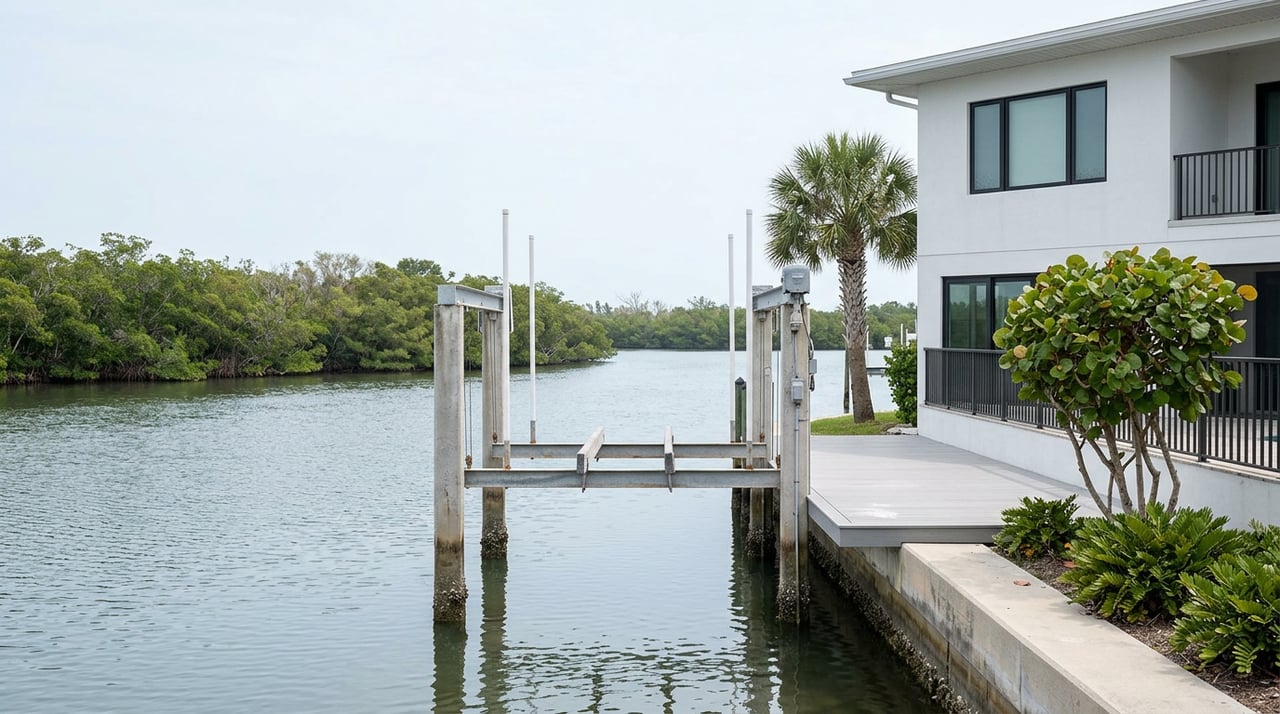
If you're evaluating a canal home, an Intracoastal-adjacent lot, or a dock near this corridor, the bridge changes the questions worth asking before you get attached to a specific boat or a specific dock design.
- Confirm the actual route your boat would take to open water, and check that route's current charted clearance rather than assuming "waterfront" means unrestricted.
- If your route runs under the current Cortez Bridge, understand that for the next few years you're working with the existing 17 to 22 foot clearance and drawbridge schedule, not the future 65-foot span.
- If you're buying with a longer horizon in mind, factor in that the constraint most likely to matter today (bridge height) is scheduled to disappear on that specific crossing by around 2030, which is a real change to plan around rather than discount.
- Weigh construction-period disruption, noise, staging equipment, altered traffic patterns, honestly against the property's price and your own timeline, rather than treating it as a footnote.
- Ask specifically whether a seller's description of "boating water" or "sailboat access" has ever been tested against your boat's actual air draft and the bridge's actual charted clearance. Those terms get used loosely across Florida's Gulf Coast, and the only way to know for certain is to check the numbers yourself.
None of this is a reason to wait four years to buy. It's a reason to buy with your eyes open about which version of the corridor you're purchasing into today, and which version arrives later.
This is exactly the kind of technical detail that separates a home's marketing copy from what actually happens the first time you take a boat out. Bridge clearances, seawall condition, dock permitting, they're not glamorous, but they're the difference between a waterfront purchase that works the way you pictured it and one that requires a workaround you didn't see coming.
If you're weighing a property near Cortez, Bradenton Beach, or anywhere else along this stretch of the Gulf Coast where a bridge, a canal, or a seawall is part of the decision, Costa Living built its practice around exactly these questions. Schedule a free consultation and we'll walk the specifics of your route to open water before you fall in love with a dock that can't do what you need it to.